

Shopify’s biggest strength is that its own tools all share one set of store data. Sidekick reads a store’s products, orders, and analytics; Flow acts on them; POS sells from the inventory; checkout and Markets run through Shopify Payments; and the AI shopping channels list the same catalog.
For merchants, that can mean less work connecting separate tools and keeping them in sync.
Our WooCommerce vs Shopify post covered what does and doesn’t change when you move from WooCommerce to Shopify, such as hosting being handled for you.
Here, we’re looking at where Shopify is particularly strong right now, from Shopify AI features and included first-party apps to checkout, B2B, and international selling. The goal is to give you an honest picture of what Shopify does well.
We build Shopify apps as well as WooCommerce products, and we know many of our readers use WooCommerce, so we’ll use it as a reference where relevant. Here’s a quick overview of the strengths and the fine print:
| Where Shopify is Strong | Fine Print |
|---|---|
| AI tools in the admin | Can give wrong answers |
| Flow and included first-party apps | Some Flow actions need higher plans |
| AI shopping channels | In-chat checkout is US buyers only |
| Checkout and Shop Pay | Bigger changes are Plus-only |
| Online and in-person on one system | POS Pro is $89/month per location |
| Cross-border with Markets | Managed Markets takes a percentage |
| B2B and retail from one store | Unlimited catalogs are Plus-only |
| Newer tools launching on Shopify first | Paid apps that add up |
Shopify AI Features Built Into the Admin
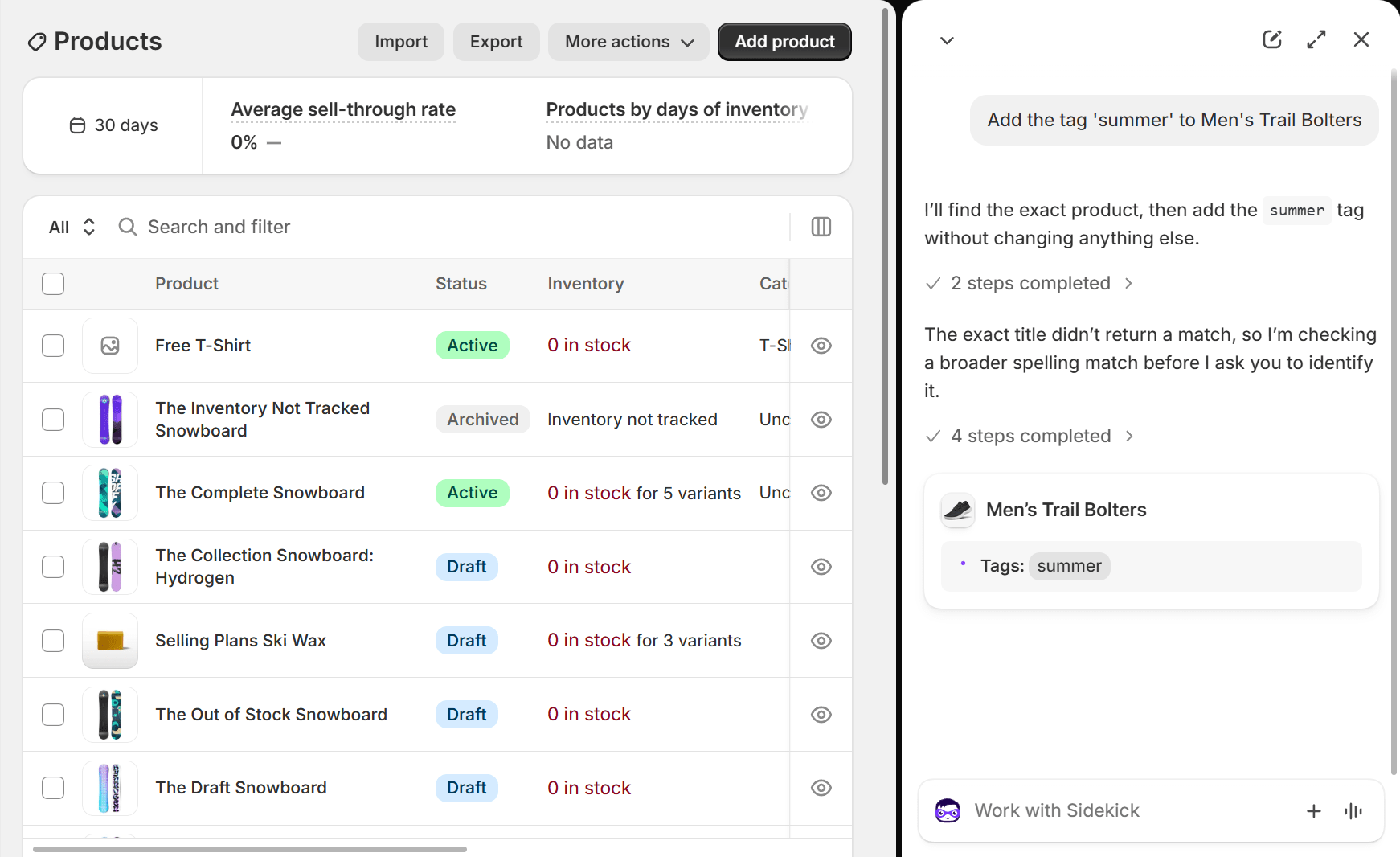
Shopify AI features are included with the Basic, Grow, Advanced, and Plus plans. Sidekick, the AI assistant inside the Shopify admin, works with a store’s own products, orders, and analytics, and can edit products, create discounts, and build Flow workflows from a plain-language request.
Shopify Magic adds text and image generation across the admin, and official Shopify apps for ChatGPT and Claude are available.
On Shopify’s Q1 2026 earnings call, president Harley Finkelstein said weekly active shops using Sidekick were up 4x year over year in Q1, with over 12,000 custom apps built with it in the quarter. Store owners are less complimentary about its accuracy, especially on technical questions and multi-step tasks.
In December 2025, one store owner on Shopify’s community forum said Sidekick gave them “a 45 minute run around of lies and promises of things it can’t do.” The fairer summary from those threads is that it’s fine for basic jobs such as sales analysis, and worth checking on anything more involved.
WooCommerce has shipped the building blocks for this kind of tool, including an MCP integration, but it still has no first-party AI assistant in the WooCommerce admin as of September 2026.
Flow and the Included First-Party Apps
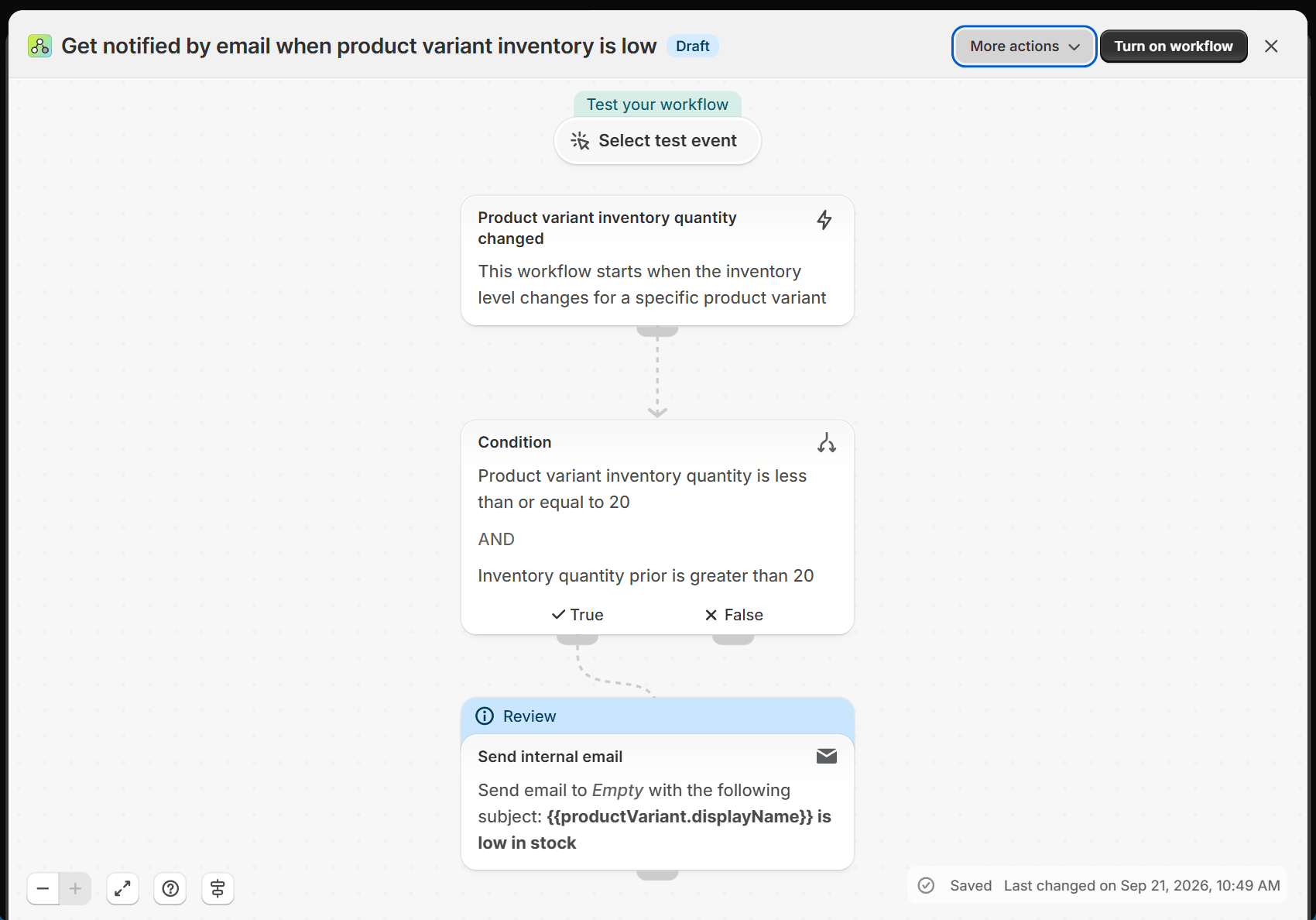
Shopify Flow is Shopify’s own automation app, included on the Basic, Grow, Advanced, and Plus plans. It runs the actions you choose when something happens in your store, using the same orders, customers, and inventory as the rest of the admin.
For example, Flow can notify you when a product’s inventory runs low, or capture payment for an order only when it isn’t flagged as high-risk. The Send HTTP Request action needs Grow or above, and tasks from custom partner apps need Plus.
As well as Flow, a few other first-party apps are included with a plan:
- Bundles creates fixed product bundles
- Inbox adds an AI sales assistant
- Search & Discovery handles storefront search and filters
They all work from the product catalog in the Shopify admin.
Merchant reviews suggest the experience varies between apps. One store owner reviewing Flow on the Shopify App Store in September 2026 said it “gives a lot of control without needing a separate automation app.”
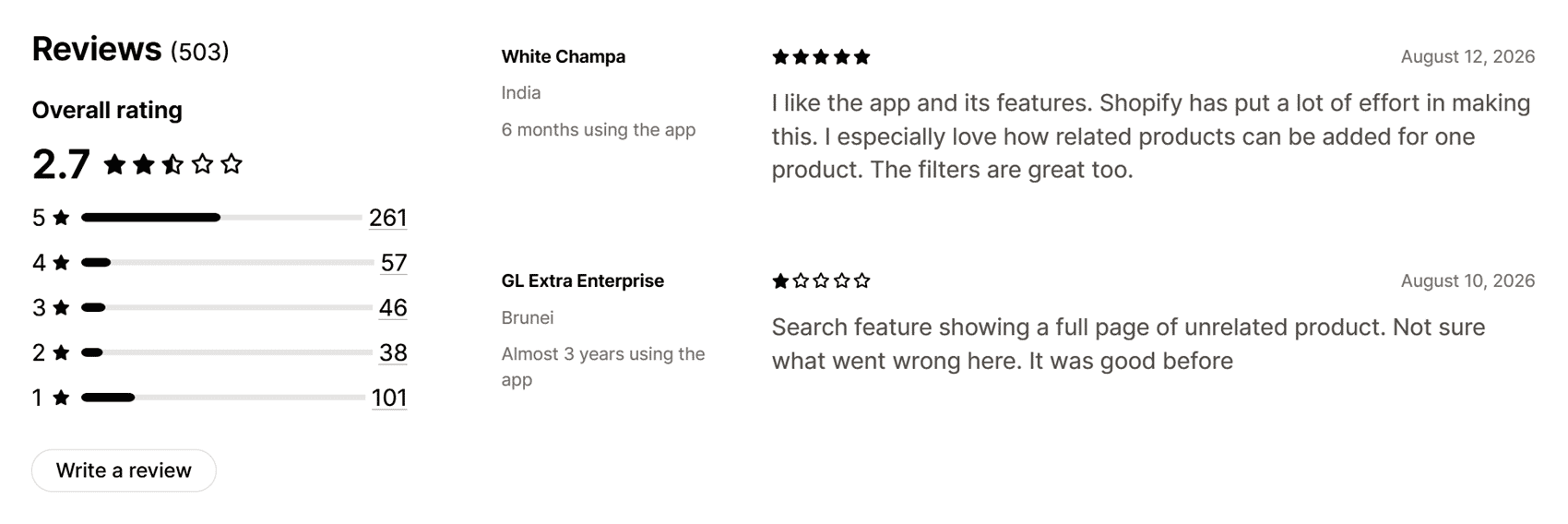
Another wrote, “Love the idea of it, but it seems to be glitchy.” Search & Discovery averaged 2.7 stars from about 500 reviews in September 2026, roughly half of them five-star and a fifth one-star. One recent reviewer complained, “A simple search that used to work great now returns hundreds of incorrect results.”
With WooCommerce, the same jobs are handled by separate paid plugins such as AutomateWoo and Product Bundles.
Selling Through AI Shopping Channels
Agentic Storefronts is a Shopify sales channel that lists a store’s products in AI shopping tools. It’s active by default for eligible stores, and merchants don’t need to maintain a separate product feed. For existing Shopify merchants, the advantage is that their catalog is already in the system these channels use.
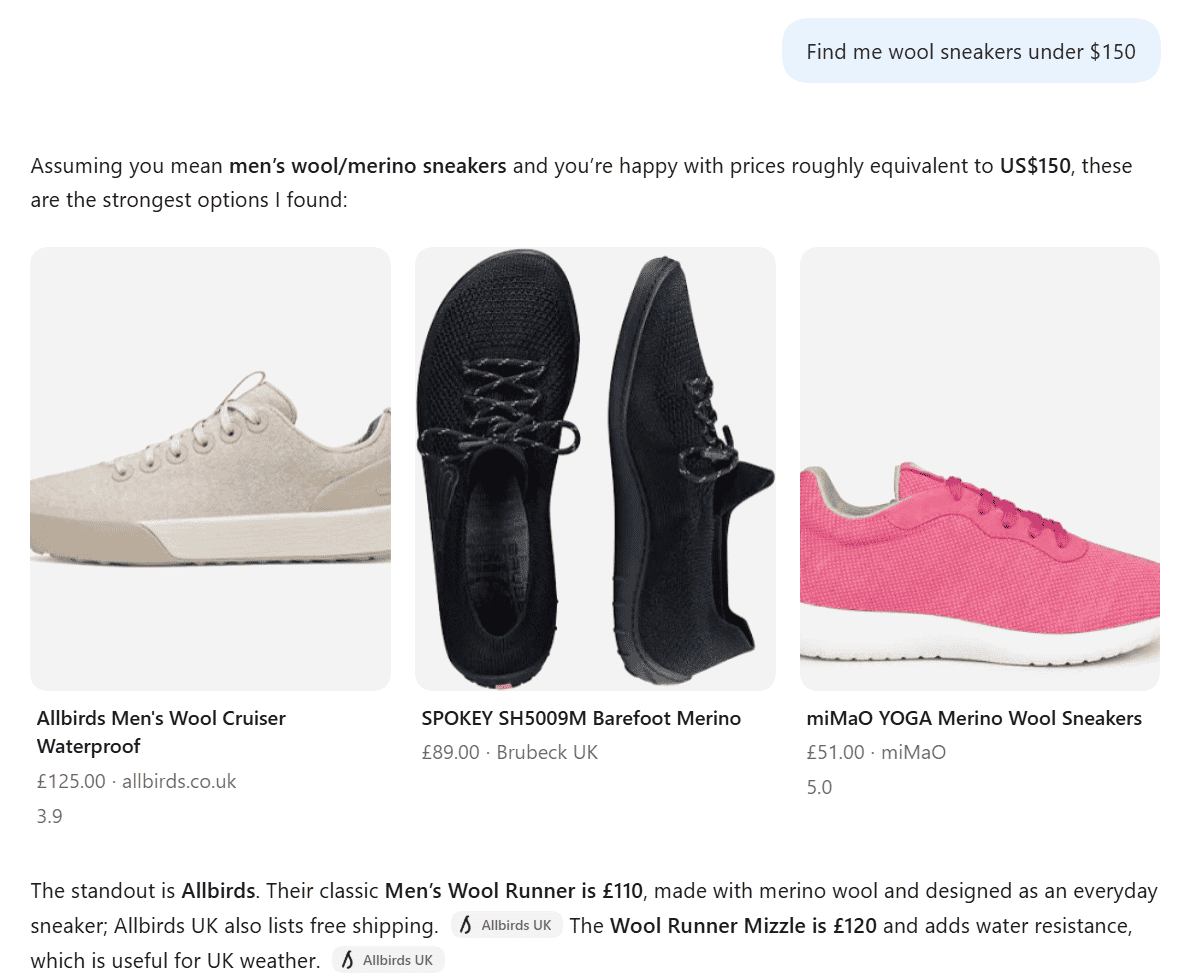
As of September 2026, the channels all work differently. ChatGPT is for discovery only. OpenAI moved away from in-chat checkout in March, so buyers finish purchases in the store’s own checkout. Microsoft Copilot, Google AI Mode and Gemini, and Meta support in-chat checkout for buyers in the United States, although Google’s is still rolling out to eligible US stores.
Access to these channels isn’t exclusive to Shopify stores. Shopify’s free Agentic plan also lists products from stores on other platforms, although Shopify’s pages don’t specifically name WooCommerce. WooCommerce’s own integrations with Google’s and Stripe’s agent checkout protocols are still labeled “Coming soon.”
Checkout and Shop Pay
The checkout experience is one of Shopify’s biggest strengths. One-page checkout is the default, and Shop Pay, the accelerated checkout that comes with Shopify Payments, saves a buyer’s details across any Shopify store that offers it and the Shop app.
This means returning customers can pay in one tap. Shopify claims “as much as 50% better conversion compared to guest checkout.” Since the Spring ’26 Edition, you can A/B test the checkout too.
Store owners see plenty of buyers choosing Shop Pay. In a 2024 r/shopify thread, one said, “We’ve seen 40% our customers checkout with Shop Pay monthly.” Shopify’s wider checkout experience has limits, though, particularly for stores that need to collect extra information.
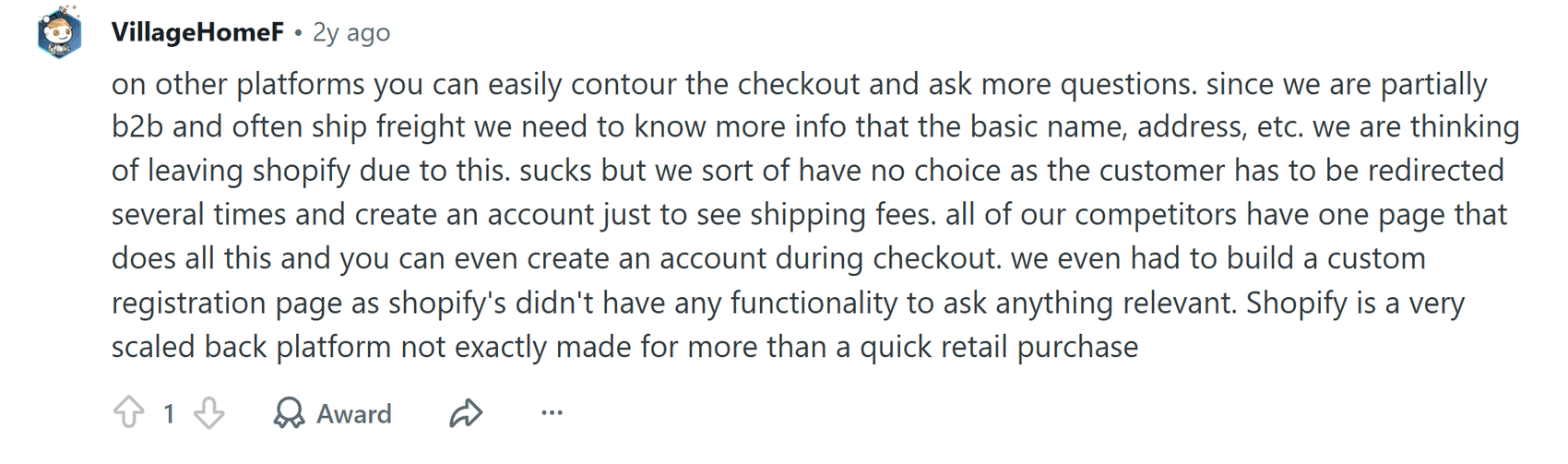
In the same thread, a part-B2B seller who ships freight wrote, “we need to know more info that the basic name, address, etc. we are thinking of leaving shopify due to this.”
Checkout Limits and Shop Pay on Other Platforms
Standard checkout customization starts on Basic, but apps that change the information, shipping, and payment steps are Plus-only. With WooCommerce, the checkout is more customizable compared to Shopify.
Shop Pay is also no longer exclusive to Shopify. You can add it to a store on another platform, WooCommerce included in principle, but there doesn’t appear to be a plugin for it as of September 2026. This means you’d need Shopify Payments eligibility and a developer to build the integration.
One System for Online and In-Person Selling
Shopify POS syncs orders and inventory between a store’s retail locations and its online store, and a customer profile created at the till can be edited from the Shopify admin. Selling in person is included on the Basic, Grow, Advanced, and Plus plans. POS Pro, which adds staff roles and inventory management, costs $89 per month per location, although Plus includes the first 20 locations.
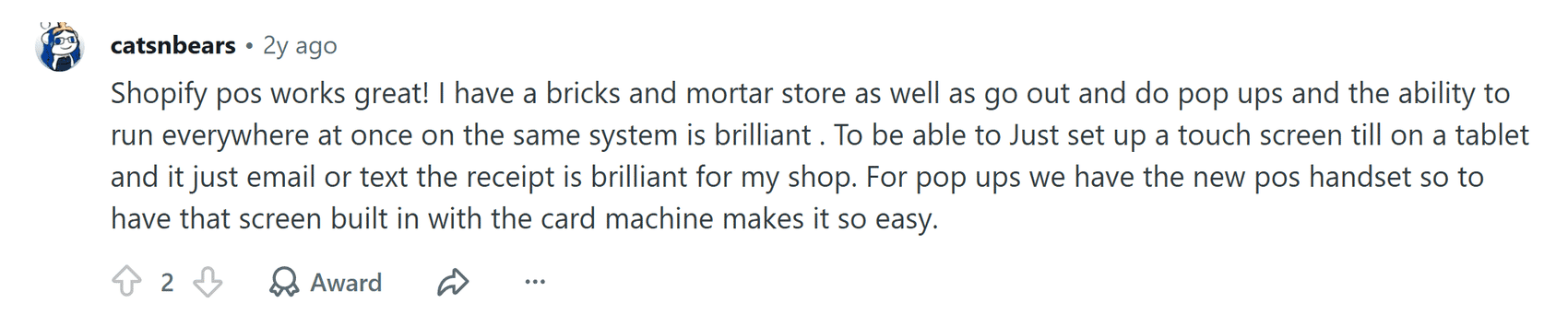
Running online and in-person sales on one system is a big draw for Shopify. In a 2024 r/shopify thread, one said, “I have a bricks and mortar store as well as go out and do pop ups and the ability to run everywhere at once on the same system is brilliant.”
The hardware gets less praise. A market seller in the same thread called the WisePad card reader “just terrible and super slow.” Shopify sells other card readers, depending on the country, and supports Tap to Pay on a phone.
WooCommerce now has its own free POS, and it has improved quickly. Shopify’s strength is how its online and in-store services connect: with POS Pro, staff can prepare online orders for collection, accept returns from online purchases, and arrange shipping for purchases made in store.
Selling Across Borders From One Store
Shopify Markets lets you avoid creating a separate store for each market. Available on the Basic plan and above, you set currencies, languages, pricing, and domains for each country from one admin. With Managed Markets, Shopify’s partner Global-e becomes the merchant of record and handles tax, duties, and local payment methods, for a 3.25–3.5% transaction fee plus 1.5% currency conversion. It requires Shopify Payments and is mainly for US stores.
One r/shopify commenter, who admits to being biased, advised, “Use Shopify Markets, not separate sites. One backend, multiple currencies/languages.” Local currencies rely on Shopify Payments, and another commenter pointed out the catch: “Shopify Payments is not available in India, so you won’t be able to do multi-currency checkouts.”
With WooCommerce, the pieces come separately. WooPayments can show prices in a buyer’s currency, translation comes from plugins such as WPML, and duties at checkout need an extension such as Avalara’s.
B2B and Retail From the Same Store
Since April 2026, Shopify’s B2B features have been included on the Basic, Grow, and Advanced plans as well as Plus. This includes company profiles for wholesale buyers, up to three catalogs with their own pricing, quantity rules and volume discounts, vaulted credit cards, and payment terms. Unlimited catalogs, direct catalog assignment, deposits, and partial payments stay Plus-only.
B2B and direct-to-consumer sales can run through one store and one admin, so wholesale orders, customers, and inventory sit alongside retail rather than on a separate site. With WooCommerce, company accounts and wholesale pricing features come from extensions such as B2B for WooCommerce.
Newer eCommerce Tools Often Launch on Shopify First
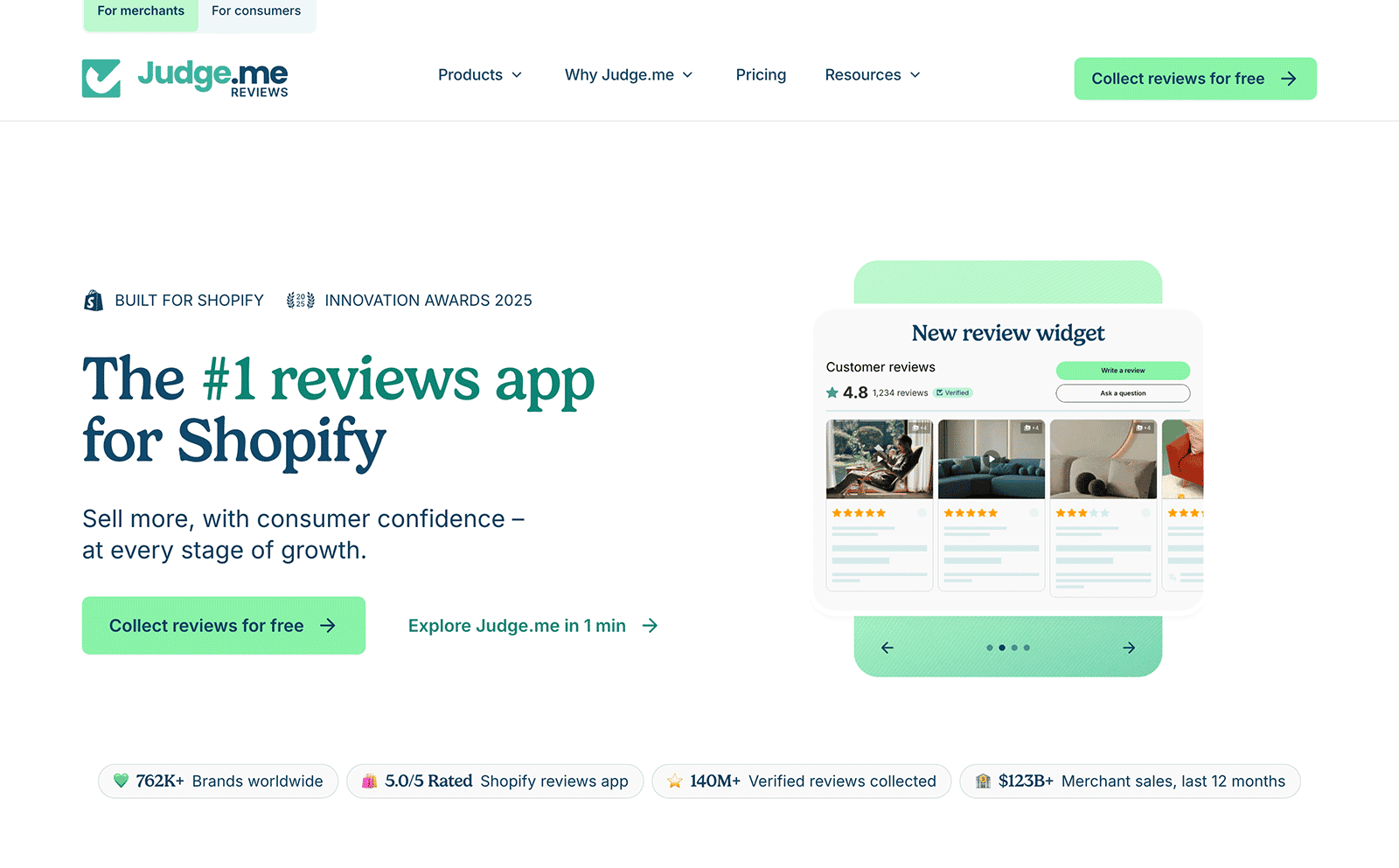
Some newer eCommerce tools never expand beyond Shopify. Intelligems, for price testing, and Rebuy, which calls itself “purpose-built for Shopify,” are Shopify-only. Judge.me went further and ended its WooCommerce support in October 2025 to “focus our full technical and support resources on Shopify.”
WooCommerce store owners felt that loss. One wrote that “we would of definitely paid a small monthly fee to continue with it.” However, on Shopify, the cost of all these apps can be a problem. As one r/shopify commenter put it, “Shopify requires way less upkeep. The downside is the nickel and diming with all the apps just to get basic features.”
Plenty of big tools, including Klaviyo, Triple Whale, and Gorgias, serve both platforms. Our best Shopify apps post covers the ones we rate.
Where WooCommerce Remains More Flexible
WooCommerce remains more flexible on ownership, customization, and cost. You own the code and the data, and you can replace any vendor, including your host and your payment processor.
Payment processing is the clearest example. Shopify adds a 0.2–2% transaction fee, depending on the plan, when a store uses a payment provider other than Shopify Payments. WooCommerce adds nothing on top of the processor’s own rates. This lets you pick the provider with the best rates for your store, including regional gateways Shopify Payments doesn’t cover, and switch later if needed.
Customization is the other. Adding a feature to WooCommerce involves adding code to your own server, so a snippet or a small custom plugin, built against documented hooks and APIs, can be live once it’s written. The checkout limits that frustrated the freight seller above don’t apply, because the checkout is yours to change. Our WooCommerce vs Shopify post covers the cost side in more detail.
Where Shopify’s Strengths Add Up
Most of what Shopify does well comes back to its tools sharing one set of store data. Sidekick, Flow, checkout, POS, Markets, B2B, and the AI shopping channels all work from the same products, orders, and customers, so merchants spend less time keeping separate tools in sync.
For a new store, that makes Shopify worth considering if several of these capabilities are part of the plan. For an existing store, it provides a useful benchmark for what could be easier, whether or not a move is on the cards. But those benefits come with limits on customization and costs that can grow as a store adds apps.
Whichever you choose, we build for both, with Shoptimizer and CommerceKit for WooCommerce and our Shopify apps.
FAQs
What are Shopify’s AI features?
Shopify AI features include Sidekick, an assistant in the admin that can edit products and build workflows, Shopify Magic for text and image generation, and official apps that connect a store to ChatGPT and Claude.
Is Shop Pay only available on Shopify?
No. Since Shopify’s Spring ’26 Edition, stores on other platforms can add Shop Pay. It requires Shopify Payments eligibility and a developer to build the integration.
Can a store that isn’t on Shopify sell through ChatGPT and Copilot?
Yes. Shopify’s free Agentic plan lists products from stores on other platforms in ChatGPT, Copilot, and other AI channels. ChatGPT sends buyers to your store to check out.
Is Judge.me still available for WooCommerce?
No. Judge.me ended WooCommerce support on October 31, 2025. Our best review plugins post covers the alternatives.




 MailPoet Plugin Review – Automated WooCommerce Email Marketing
 Twitter announces new eCommerce features
 Quick Tutorial: Adding a Twitter Widget to your Site
 WordPress Database/MySQL optimisation guide